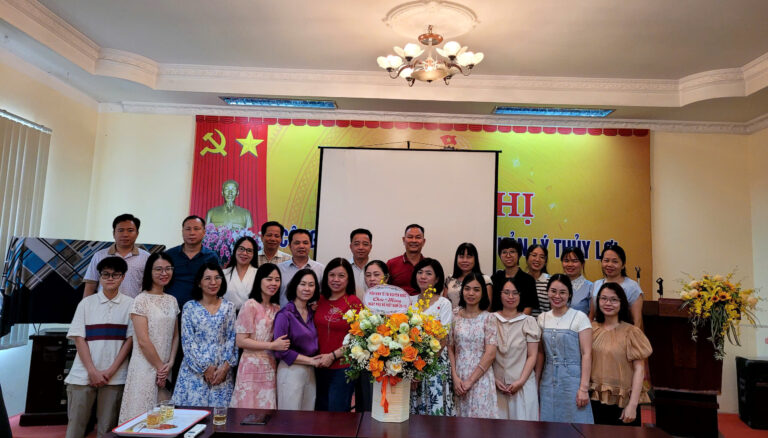
On the morning of 25 June 2026, the doctoral training institution of the Vietnam Academy for Water Resources held an extended seminar to review PhD candidate Dang Minh Tuyen’s dissertation, “Research on Optimal Water Use for the Tidal Irrigation System in Southern Ninh Binh”.
The seminar provided an academic forum for discussion, critical review and refinement of research relevant to tidal irrigation management, as efficient water use, adaptation to saline intrusion and sustainable agriculture become increasingly urgent.
Participants included Professor Tran Dinh Hoa, Director General of the Academy and Head of its training institution; Dr Nguyen Tiep Tan, Deputy Director General; leaders of the Organization and Administration Department; and specialists in water resources engineering, irrigation, hydraulics, agricultural economics, the environment, irrigation infrastructure management and sustainable agriculture.
The seminar was chaired by Dr Nguyen Tiep Tan, Deputy Director General of the Vietnam Academy for Water Resources.

Associate Professor Pham Hong Cuong, Deputy Head of the Organization and Administration Department, introduces the purpose, participants and programme.

Professor Tran Dinh Hoa delivers the opening address, emphasizing the importance of drawing on scientists’ expertise to help the candidate refine his dissertation before proceeding to subsequent stages under doctoral training regulations.

PhD candidate Dang Minh Tuyen presented the main dissertation findings. Although the southern Ninh Binh tidal irrigation system has large infrastructure capacity, actual service provision is constrained by tides, dry-season saline intrusion, differing water intake conditions, cropping patterns, rural labour, markets and environmental pressures. The dissertation therefore approaches water use more comprehensively than conventional single-objective assessment.
In the dissertation, “optimal water use” goes beyond supplying sufficient irrigation water. It seeks appropriate land–water use patterns under uncertain and spatially differentiated water availability, with simultaneous constraints on water quantity, water quality and development objectives. This is consistent with integrated water resources management, in which irrigation system performance is assessed in terms of economic outcomes, production, livelihoods and the environment.
MOFLP-2T: linking system-wide optimization with irrigation-zone allocation
The dissertation develops and tests Multi-Objective Fuzzy Linear Programming with a Two-Tier Structure (MOFLP-2T). The first tier identifies the optimal cropping pattern for the entire system; the second allocates that result across 13 irrigation zones according to water supply conditions, area limits, salinity and crop suitability.
At system level, four objectives are quantified: maximizing net economic benefits, crop output and labour demand/workdays as a livelihood indicator, while minimizing environmental pressure using a pesticide indicator. Variable agricultural parameters, including water availability, yields, selling prices, costs, labour and environmental pressure, are represented by triangular fuzzy numbers. This reflects fluctuating data for which a complete probability distribution cannot yet be adequately established.
At spatial allocation level, the model tests the feasibility of the optimal solution in each irrigation zone. This is particularly relevant to tidal systems: total water availability does not always reflect the ability to supply individual zones. A system-wide surplus can coexist with local shortages or stress because of infrastructure locations, conveyance routes, intake conditions and saline intrusion.

Quantitative results demonstrate the value of the two-tier structure
The model produced a compromise solution with Φ* = 0.7489, indicating a relatively high combined satisfaction level while balancing competing objectives. The optimal solution yielded approximately VND 3,500.69 billion in net economic benefits, 432.66 thousand tonnes of crop output, 7.81 million equivalent workdays, dry-season water demand of 277.117 million m³, and system water productivity of approximately VND 12,636/m³.
An important finding is the strong compatibility of economic, output and labour objectives within the optimal solution space, whereas the environmental objective clearly trades off against the other three. In predominantly rice-based production systems, socioeconomic gains may therefore coincide with increased environmental pressure. Environmental improvements require sufficiently strong constraints and policies, rather than adjustments to soft model priorities alone.
The two-tier model identified Z03–Song Ben Dang as a local bottleneck, with the available-water-to-demand ratio exactly at 1.000 despite a system-wide surplus. System-level optimization alone can overlook such spatial bottlenecks; irrigation-zone allocation makes local operational constraints visible and supports specific management recommendations.
Many scientists at the seminar described the dissertation as innovative, substantial and scientifically rigorous, and appropriate to water resources engineering. They valued the use of quantitative tools to assess integrated irrigation system performance rather than isolated technical or economic indicators. Participants noted that the research broadens the treatment of irrigation water as an economic resource linked to public services, rural livelihoods and environmental responsibility.
Experts also welcomed the connection between integrated water resources management, sustainable development and multi-objective optimization. The approach has potential as a decision-support tool for irrigation management organizations, particularly in tidal systems facing saline intrusion, variable water availability, changing production patterns and increasing water-use efficiency requirements.
The seminar offered detailed recommendations for improving the dissertation: clarify its title, research subject and scope; strengthen the rationale for objectives F1–F4; update national and international literature; standardize terminology; reconcile survey data and sample sizes; substantiate model constraints; clarify the role of the Kim Dai sluice and navigation lock and inherited hydraulic data; and interpret labour and environmental indicators, winter crops, perennial crops and model transferability more cautiously.
Some experts recommended a clearer distinction between the theoretical model, its application and the validation undertaken in southern Ninh Binh. They called for stronger hydrological and hydraulic justification of the two-tier structure, clearer descriptions of cropping patterns and seasonal water-use relationships, and closer comparison of model outputs with local operational and management conditions. These recommendations are relevant both to dissertation refinement and to practical irrigation optimization models.
Research and applications for tidal irrigation systems
The findings and discussions point beyond the specific southern Ninh Binh case towards a broader research direction in water-use optimization for coastal tidal irrigation systems. Where conditions vary considerably across space, supply depends on salinity-control infrastructure and multiple objectives must be balanced, MOFLP-2T can be further tested, calibrated and extended.
Further work could link optimization with short-time-step hydraulic models, update water availability scenarios under climate and socioeconomic change, broaden environmental indicators, incorporate brackish- and saline-water aquaculture, and develop decision-support procedures for irrigation managers. These directions support the transition from infrastructure management alone towards water services, water-use efficiency and sustainable agricultural development.

In closing, Dr Nguyen Tiep Tan recognized the dissertation’s substantial scope, scientific content, relevance to water resources engineering and practical value for tidal irrigation management. He asked the candidate to carefully address the comments and review the title, objectives, research subject, scope, datasets and interpretation of results before submitting the dissertation for the next defence stage.
The extended seminar was conducted in a constructive, responsible academic spirit. The scientists’ critical feedback helped improve the dissertation and highlighted the need for modern quantitative methods in integrated water resources management, optimal water-use patterns and more effective tidal irrigation system operation in Vietnam.
Reference: Vietnam Academy for Water Resources seminar report.